by Taye Newman | Jun 6, 2018
Emergency Food Hampers
Since early 2017, Feeding Nunavut has provided funding for a pilot Emergency Voucher program in Igloolik. The purpose of the program is to service households that find themselves in emergency, “no food” situations within the community. This program does not provide on-going support (such as a food bank) but instead, provides one-off immediate food relief.
Assistance in the form of food hampers benefit recipients because they provide immediate access to food and critical supplies in a way that is respectful of individual and family diet and nutrition needs.

Over the last year, this program has disbursed food aid vouchers to provide iron-rich foods for children with tuberculosis and food relief grocery items for households in no-food situations. Under extreme circumstance, this program has also provided emergency winter heating fuel for an Elder, emergency house fire aid and emergency bereavement food aid for two families to help cover the influx of extended family members attending funerals.

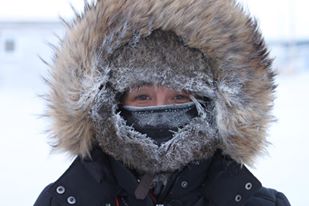
Akittiq Angutiqjuaq
The community of Igloolik recognizes the merits of this program, and has included it under the Hamlet’s umbrella of the food assistance programming managed by Akittiq Angutiqjuaq and her team of volunteers.
Managing food aid resources under one umbrella will empower Akittiq to provide more effective food assistance for the community. We have had the pleasure of working with Akittiq in the past and know her to be fair, honest and a respected member of the community. We are confident the hamper program will flourish under her supervision.
WE NEED YOUR HELP
This Emergency Hamper program is entirely funded by people like you. We would appreciate it if you can help us ensure this program is available for months to come by making a donation or sharing this page with your friends, family and social networks.
Donations are needed and appreciated more than you know. Thank You!
Feeding Nunavut is incorporated under the Canada Not-for-profit Corporations Act. Registered in Ontario and Nunavut. Donation receipts cannot be used for income tax purposes. Read why we are not a charity. For specific information on what we do and programs we have supported, read our Annual Report 2015/16

by Talya Rotem | Dec 23, 2016
We Canadians believe ourselves to be quite the generous lot. We dig deep into our pockets to donate to international disaster relief for epidemics in Africa and devastating hurricanes in Haiti. In fact, 82% of us donated money in 2013 to charities and non-profits to the tune of $12.8 billion dollars. It goes without saying that this generosity applies to emergencies within our own borders too: Canadians recently donated $300 million dollars to Fort McMurray disaster relief efforts. But disasters closer to home also bring out a different type of generosity. Many of us put away our wallets and replace financial donations with in-kind goods. In the Fort McMurray example, the Edmonton Emergency Relief Services also received tonnes of diapers and food for the families. Yet, despite donors’ good intentions, these “truckloads of donated goods that [were] soiled, unnecessary, and [got] in the way”, ended up hampering relief efforts. Apparently, in-kind donations are an ineffective substitute for dollars when the problem requires more than a simple snag-bag-n’-tag solution.

Spilling the beans on in-kind food donations
We don’t have to look too far or wide across the country to find another glaring example of in-kind giving that could be better served through in-money donations. The Canadian ‘phenomenon of physical generosity’ is unmistakably present in our response to hunger and food insecurity in the North. Southerners take their cash to the local supermarket and purchase (inexpensive) food to ship (costly) care packages to Inuit individuals and families. They are generous with their time and resources to do their part in the fight against hunger. But like the devastation created by the Alberta wildfires, the issue of food insecurity in Nunavut cannot be solved through goods.
The rate of food insecurity in Nunavut is over four times the national average (2011-2012). Kids go to bed hungry, school breakfast programs run out of food, and fathers starve themselves so that their children can eat. It makes sense then that no one would want to say ‘STOP sending food’ to a territory that Food Banks Canada recognizes as having “the highest documented rate of food insecurity for any indigenous population living in a developed world.” In this crisis, Southerners are helping the hungry, and they are equally aware that they offer a band-aid solution while bigger players work on developing large-scale solutions:
“There are many things we can do to help enact a change, which are suggested on the Feeding My Family page, but this will take time and the people are hungry now.”
— Helping Our Northern Neighbours Facebook Group
Yet, tin charity to Nunavummiut (people of Nunavut) does little to tackle the food insecurity problem, in addition to being unhealthy, culturally inappropriate, and potentially wasteful. Southerners need to reconsider where and how they share their time and energy to fight hunger in Inuit communities. We need to start thinking upstream so that the tide of hungry people is slowed. Instead of feeling good by donating food to “feel like we’ve done our part… [and] think the problem is solved.,” we need to help bring about lasting change by supporting Inuit with lived experience, and those working to help them locally.
What’s the beef with food donations?
Local food advocates have been asking Southerners for years to help raise awareness, advocate for change, or to help in ways that makes most sense – none of which include donating food. Imagine what we could accomplish if only a small portion of the 60% of Canadians that donated items to food banks in 2013, answered the call for monetary or other types of support:
- Leesee Papatsie, the founder of Feeding My Family, a Facebook Group working to raise awareness about the outrageous cost of food in Northern communities, would like to see Southerners take on a special role as non-indigenous people, “because they can write to their members of Parliament, they can spread awareness, they can send donations, sign petitions.”
- Wade Thorhaug, President of The Qayuqtuvik Society, a non-denominational registered non-profit that runs the Iqaluit Soup Kitchen everyday of the year, hopes Southerners donate funds not food. He recognizes that direct food donations can help in certain circumstances, but admits that Southerners “often spend large amounts on shipping which could be spent more efficiently by the recipient organization”.
Inuit-centric organizations also make recommendations for upstream solutions to food insecurity:
- The Nunavut Food Security Strategy and Action Plan 2014-16 identified six food security themes, including: the promotion of country food; (local) access to affordable and preferably nutritious store-bought food; supporting and promoting the potential for local food production; empowering Nunavummiut through life skills, programs and community initiatives; and advocating for a strong social safety net through policy and legislative measures.
- The Hunger in Nunavut group offered three food security recommendations: “improving hunting capacity, improving food processing and distribution capacity, and improving community awareness about local food.”
So Why Are You Still on the Great Canadian Gravy Train?
In economic terms, shipping food to hungry Inuit doesn’t make sense. Putting funds into the hands of organizations like the Qayuqtuvik Society would enable local food advocates to make better use of their resources, buy fresh, high-quality food whenever possible, and minimize administrative costs:
“In the case of Nunavut, the disincentive for sending food is extreme given the cost of air freight. Most organizations here have their own strategies for minimizing freight costs, including making sealift orders in the summer and ordering through companies that can reduce the food cost by applying the Nutrition North Canada subsidy (which is only available to certain companies).”
— Wade Thorhaug, President, Qayuqtuvik Society
Southerners need to come around to support these arguments, read these reports and recommendations, so that we start thinking beyond stemming hunger and moving to stop the problem at its source. We could work to raise awareness and advocate for basic income guarantees, better infrastructures, and support for local hunter programs to strengthen the local economy and empower families and individuals. Food can’t achieve any of this. After all, no one has ever paid an electricity bill with a tin of tuna.


by Taye Newman | Dec 15, 2016

Sakku School in Coral Harbour Nunavut, is asking for donations for their school breakfast program. The school has over 350 students from K-12 who are offered breakfast to each and every morning.
 Typically the program feeds around 120 students each day, with more of them being the younger students from kindergarten to grade 6.
The breakfast food plan is structured around healthy options that have been approved by a certified nutritionist.
Students are given a meal with at least three out of the four food groups varying from hot and cold breakfasts. Groceries for the breakfast program are purchased fresh from the stores, and typically include items such as fruit, eggs, and bread.
Nutrition is expensive.
Nunavut food insecurity and hunger statistics are staggering:
• 60% of the territories children live in food insecure homes
• 70% of Inuit preschool children live in food insecure homes
• 76% of severely food insecure children regularly skip meals
Source: Aboriginal Food Security in Northern Canada

by Taye Newman | Jun 15, 2016
“In the belief system common to Nunavut Inuit, harvested food is seen as a gift from nature, in which animals offer themselves to the hunter or fisher, and where the sharing, distribution, and consumption of wild foods is closely linked to cultural identity (Wenzel, 1995, 2013). As one Iqaluit participant noted, “food sharing is one of the important fibres of the culture.” Food sharing has been identified as particularly important for households in need, including the elderly and those with limited income (Beaumier and Ford, 2010)”.
– Excerpt from Report : Food policy in the Canadian North: Is there a role for country food?
It was my first trip to the Arctic. The first time out on the tundra heading towards an igloo. I didn’t know what to expect, but I was pumped. The igloo was built to give tourists like me, a sense of old-school Inuit life. What happened inside that igloo was magic.
We were greeted by two lovely Elders, Susan and Marie, who served us hot tea and pilot biscuits. We spent the afternoon in the igloo with Susan and Marie. The conversation was easy. We shared stories. We laughed. We cried.

Qulliq or kudlik lamp. Photo Credit: Tereina Neubauer
Marie prepared seal in a light broth on the cook stove. While I had eaten seal before, it was not prepared in an igloo by an Inuk Elder! I was pumped and feeling very privileged! The experience did not disappoint. The seal warmed me from the inside out. It was delicious. I probably had more than my share. Oops. Sorry.
What does seal taste like? I suppose it depends on how it is prepared, on this day it was “fall off the bone tender” and tasted similar but more delicious than beef.
The smell of the cooked seal seemed to lure the guides and hunters. Soon our igloo was standing room only. I remember watching the men enjoy the seal. Watching them eat seal, made me realize the seal was not just nourishment or a traditional food staple. I was watching something more. The energy in the igloo changed. I was witnessing a deep love, a complete respect, a vital bond. The first dance at a wedding.
I don’t have the words to describe the experience of sharing a meal of seal with Inuit on that day. But I am starting to understanding why country food is so important to the culture and why Inuit are called the ‘People of the Seal’.
“We will promote country food as a foundational food for Nunavummiut”
– Nunavut Food Security Coalition
During the time in the igloo, as well as an afternoon visit for tea at Susan’s house, we were showed many examples of how every part of the animal is used. Most people are aware of clothing made from fur and hides, but animal bladders are used as storage containers, bones are used to make tools … and even games! (We played a game, I lost!) Susan has a tupperware container of these bone tools. She even has the tool, crafted from a caribou hip bone, that she used as a young mother to collect her baby’s pee from their bed made of caribou hide. Susan explained how an Inuit mother knows when a baby is about to go to the bathroom. The baby is then removed from the amauti or if sleeping in bed, the collection tool can be placed before the baby eliminates. Nowadays, of course diapers are used. But I found the history to be fascinating stuff.
The common theme of many conversations we had in Nunavut was country food. Country food, or the traditional food of Inuit is acquired from the land and sea and is healthier and less costly than modern foods. During these conversations, we learnt how important country food is to the Inuit culture. We heard about the nutritional benefits of country food, the desire for more country food, and the difficulties that some have accessing country food. This helped identify an exciting new venture for Feeding Nunavut and its donors to contribute to food security in Nunavut by supporting local hunters and the sharing of country food!
Beluga Whale Nutrition Facts
Polar Bear Nutrition Facts
“Per kilo, it’s cheaper to reap the bounty from the backyard than to fly it in”.
Todd Johnson, Kivalliq Arctic Foods, Rankin Inlet
“Inuit woman and child standing on bowhead whale after a 2002 subsistence hunt” by Ansgar Walk licensed under CC BY-SA 2.5. Taken in Igloolik, Nunavut.
Despite anti-poverty efforts, hunger in Canada has not decreased – and it has now reached epidemic levels in Nunavut, where almost half of households suffer from food insecurity, according to a new study by University of Toronto researchers. The Nunavut Food Security Coalition identified country food as foundational food for Nunavummiut and included it as part of the Nunavut food security strategy and action plan.
We chatted with hunters about the challenges they face obtaining country food, particularly since NTI stopped the Nunavut Hunter Support program in 2014. Hunters repeatedly mentioned that often the barrier to hunting is simply MONEY: money for snowmobile/ATV maintenance and repair, gas money, hunting grub (food) money, naptha money and ammunition money.
“THE HUNTER NEEDS TO HAVE TOOLS, TRANSPORTATION, AND ENERGY. YOU NEED ALL THREE OR YOU’RE NOT ABLE TO HUNT.”
– Report : Food policy in the Canadian North: Is there a role for country food?
While, we are not able to fund snowmobiles and expensive repair right now, there are items on the “barriers to hunting” list that we are able to help with, such as providing supplies of gas, food, ammunition and naphtha.

Community member, Diane Qingnatuq, reacts with delight to a Feeding Nunavut donation of country food to the Gjoa Haven Food Bank – fish, muskox and caribou!
Harvesting Food Security
Starting with one community in Nunavut, we have designed a Hunter/Fisher pilot program designed to:
• Provide community country food sharing in the traditional Inuit cultural way. Support school meals, Elders, community emergency food relief programs and/or food insecure households with donations of country food.
• Increase opportunities for hunters and fishers by removing some of the common cost barriers.
• Encourage Youth skills land trips by providing supplies and compensation to participating Hunters and/or Elders.
• Sponsor hunts that will provide country food for Community Feasts.
In addition to contributing to food security, this project should compliment the existing Nunavut Country Food Distribution Program and has the potential to become a poverty reduction initiative. Hunting and land trip excursions will coincide with wildlife migration and the country food needs of the community. Frequency is reliant on the availability of funding.
You Can Be Part of This Exciting Venture!
Supporting Hunters Can Contribute to Food Security in Nunavut
We use the secure PayPal platform to manage credit card and PayPal donations.

by Talya Rotem | Mar 11, 2016
When a food bank puts out a call for donations, Canadians may be motivated to share their boxes of mac n’ cheese, cans of baked beans, or schools of sardine tins that have been collecting dust in their pantry. But they shouldn’t fool themselves into believing that all food banks would welcome canned currency as a replacement for real dollars. Many food banks, soup kitchens, and school meal programs, like those operating in Northern Canada, would much prefer it if southern Canadians kept their lunch but shared their lunch money. They need financial donations so that they can serve a growing food insecure population; support a healthier community; and continue to play a central role in the preservation of culture through dietary traditions and lifestyles.
In southern Canada, food prices are generally stable and spike only when a cold snap affects the cost of imports from warmer climate countries, or when the Canadian dollar plummets. In Northern Canada, however, store-bought foods are flown-in and arrive to market with an outrageous price tag already attached. The high-cost of shipping heavily impacts donation packages too, sometimes exceeding the price of the canned items themselves because of their heavy weight and bulk. Food banks in Nunavut could make better use of these costs to serve their community on a regular basis.
⦁ Food banks and soup kitchens can purchase bulk or wholesale items at a fraction of the cost of buying and shipping donated retail food items.
Financial donations enable food programs to make locally-based decisions on how best to allocate their funds. Food banks can supplement a single family’s meal, or soup kitchens can purchase raw or bulk ingredients so that they can cook a meal for a larger group. Dollar for dollar it makes more fiscal sense to put funding into the hands of food banks that can make the money stretch instead of wasting funds on non-edible shipment costs.
⦁ Food banks and school meal programs can use monetary donations to ensure they support their community without major disruptions.
As food insecurity and poverty continues to rise in Nunavut, more pressure is placed on food programs to serve larger numbers of vulnerable people, and increasingly, more children. The Niqinik Nuatsivik Nunavut Food Bank is a good example of this growing need: it started serving 30 families when it first opened its doors in 2001, and now works hard to ensure that it has enough to provide for 120 families every two weeks. Rising food insecurity is also affecting school programs like the one at the Sam Pudlat school in Cape Dorset, Nunavut, that recently ran out of funding to provide hot breakfasts and healthy snacks for it’s students.
Financial donations would enable food banks to operate at higher capacities, and still have some funding to cover operational costs or unexpected emergency funds, like a burnt out stove element, or when the Canadian dollar drops drastically.
Northern food insecurity and poverty resulted from various socio-economic, political and colonial factors, including 30-year-long animal welfare campaigns that curtailed the Northern fur trade, and the primary loss of hunting and land skills, and the transfer of that knowledge to the next generation of Inuit, because of the high cost of hunting equipment, supplies and fuel. These and other circumstances have led to a ‘nutrition transition’ to processed, high-fructose, zero caloric foods due in part to cost, access, and an unfamiliarity with some raw unprocessed ingredients on store shelves. Western diseases like obesity, heart disease and diabetes are appearing in many Northern Inuit communities, in which case cheap, non-perishable foods from the south become wasteful and potentially harmful to people developing western nutrition-based illnesses.
⦁ Food banks are best equipped to understand the nutritional needs of local families and children, as well as and individuals’ health requirements, dietary needs, or personal preferences. Funding food banks helps to cut down on worsening health conditions by removing the possibility that shipments of high-fructose foods, for example, end up in the hands of pre-diabetics. Financial donations to school nutrition programs, like the Tusarvik School breakfast program in Naujaat, Nunavut, can be used to purchase fresh produce and healthy snacks for students who would otherwise not have access to them.
Food is an important element of identity and culture. When southern Canadians ship food up north, they unwittingly attach invisible strings to their packages. These food donations could result in a drastic alteration of the Inuit culture through an introduction to “acceptable” western dietary preferences and practices. Assimilated food customs and preparation methods can alter local opinion about traditional foods as being backwards or un-modern.
⦁ Food banks play an important role in cultural preservation
Food banks can preserve cooking knowledge, dietary customs and habits. They can minimize wasted food (and associated shipping losses) by feeding foods that are interesting, customary, or those that match a local preference. Soup kitchens can prepare and share recipes that do not require western cooking knowledge or that promote new-age health kicks.
⦁ Food banks play an important role in local hunting and economy
Food banks can purchase locally-available country food, like hunted seal or caribou, or they can subsidize a family’s meals with traditional bannock bread. Inuit children and youth are transitioning to the western diet faster than any other age group and therefore food banks could share or prepare meals that expose younger generations to “develop a taste for their own foods“.
Shipping cans to food banks in Nunavut simply does not make cents
Pantry castaways don’t fit the bill for every food bank, especially those that serve communities outside of a local food drive perimeter.
Shipping food to the north is a short-term Band-Aid solution to food insecurity, and is a waste of valuable funds. A family in southern Canada that buys $100 worth of food to ship to the north will likely have to pay more than $150 dollars in shipping costs. These are lost funds since the money could go further (and be spent more wisely) in the hands of food program managers. But the loss doesn’t stop there. Shipment costs are wasteful because southern shipments cannot take advantage of the Nutrition North Canada program (NCC), a federal government subsidy for commercial shipments of nutritious foods to the north. Local food programs across Nunavut can go beyond providing a single (and expensive) meal-in-a-box, if they are given the financial opportunity to do so. Southern Canadians need to put away the packing tape, and focus instead on putting the bank back into the food bank through hunger awareness campaigns like Feeding Nunavut’s Skip-a-Meal campaign.
Additional resources
Read Food Bank Canada’s HungerCount 2015, a report from an annual study of more than 4,000 food banks and programs in every province and territory across Canada.
Northern food banks and soup kitchens, rely on donations from people like you to serve the need in their communities. Please support their important work.
Visit Directory

by Taye Newman | Jun 22, 2015
The Tusarvik school breakfast program is able to enjoy a nutritious boost because of generous donations from people like you. Donated dollars are used to purchase fresh produce and healthy snacks that would otherwise not be available to students as part of the school meal program.
Donated dollars fund:
- “Big Breakfasts” that serve the entire school population of 400+ students
- Batches of Caribou Stew
- Healthy snacks of juice, fruit and granola bars stored in the office and available daily to students if needed.
Posted with Tusarvik school permission. Photo Credit: Julia MacPherson
The Tusarvik School is in Naujaat, Nunavut located on the Arctic Circle. Like all schools in remote northern communities, the entire year of school breakfast supplies are shipped to the school during sealift season. Transport by sealift makes it impossible to include fresh fruit in the breakfast program. Because of high grocery fly-in costs, the school cannot afford to purchase fresh produce at the local grocery store. Your donations can provide Tusarvik school with the funds needed to supplement the breakfast program with fresh produce and other nutritious food and healthy snacks.
Please donate to Tusarvik School Breakfast Program. Your support will make it possible for the school to purchase fresh produce and emergency healthy snacks this school year!
A huge THANK YOU to all that donate to the Tusarvik breakfast program!
And a big HIGH FIVE to school volunteers and staff that go above and beyond to make these donations successful!




 Feeding Nunavut is incorporated under the Canada Not-for-profit Corporations Act. Registered in Ontario and Nunavut.
We support northern community-based programs to help these programs better serve the needs of their communities.
Feeding Nunavut is incorporated under the Canada Not-for-profit Corporations Act. Registered in Ontario and Nunavut.
We support northern community-based programs to help these programs better serve the needs of their communities.