We Canadians believe ourselves to be quite the generous lot. We dig deep into our pockets to donate to international disaster relief for epidemics in Africa and devastating hurricanes in Haiti. In fact, 82% of us donated money in 2013 to charities and non-profits to the tune of $12.8 billion dollars. It goes without saying that this generosity applies to emergencies within our own borders too: Canadians recently donated $300 million dollars to Fort McMurray disaster relief efforts. But disasters closer to home also bring out a different type of generosity. Many of us put away our wallets and replace financial donations with in-kind goods. In the Fort McMurray example, the Edmonton Emergency Relief Services also received tonnes of diapers and food for the families. Yet, despite donors’ good intentions, these “truckloads of donated goods that [were] soiled, unnecessary, and [got] in the way”, ended up hampering relief efforts. Apparently, in-kind donations are an ineffective substitute for dollars when the problem requires more than a simple snag-bag-n’-tag solution.
Spilling the beans on in-kind food donations
We don’t have to look too far or wide across the country to find another glaring example of in-kind giving that could be better served through in-money donations. The Canadian ‘phenomenon of physical generosity’ is unmistakably present in our response to hunger and food insecurity in the North. Southerners take their cash to the local supermarket and purchase (inexpensive) food to ship (costly) care packages to Inuit individuals and families. They are generous with their time and resources to do their part in the fight against hunger. But like the devastation created by the Alberta wildfires, the issue of food insecurity in Nunavut cannot be solved through goods.
The rate of food insecurity in Nunavut is over four times the national average (2011-2012). Kids go to bed hungry, school breakfast programs run out of food, and fathers starve themselves so that their children can eat. It makes sense then that no one would want to say ‘STOP sending food’ to a territory that Food Banks Canada recognizes as having “the highest documented rate of food insecurity for any indigenous population living in a developed world.” In this crisis, Southerners are helping the hungry, and they are equally aware that they offer a band-aid solution while bigger players work on developing large-scale solutions:
“There are many things we can do to help enact a change, which are suggested on the Feeding My Family page, but this will take time and the people are hungry now.”
Yet, tin charity to Nunavummiut (people of Nunavut) does little to tackle the food insecurity problem, in addition to being unhealthy, culturally inappropriate, and potentially wasteful. Southerners need to reconsider where and how they share their time and energy to fight hunger in Inuit communities. We need to start thinking upstream so that the tide of hungry people is slowed. Instead of feeling good by donating food to “feel like we’ve done our part… [and] think the problem is solved.,” we need to help bring about lasting change by supporting Inuit with lived experience, and those working to help them locally.
What’s the beef with food donations?
Local food advocates have been asking Southerners for years to help raise awareness, advocate for change, or to help in ways that makes most sense – none of which include donating food. Imagine what we could accomplish if only a small portion of the 60% of Canadians that donated items to food banks in 2013, answered the call for monetary or other types of support:
Leesee Papatsie, the founder of Feeding My Family, a Facebook Group working to raise awareness about the outrageous cost of food in Northern communities, would like to see Southerners take on a special role as non-indigenous people, “because they can write to their members of Parliament, they can spread awareness, they can send donations, sign petitions.”
Wade Thorhaug, President of The Qayuqtuvik Society, a non-denominational registered non-profit that runs the Iqaluit Soup Kitchen everyday of the year, hopes Southerners donate funds not food. He recognizes that direct food donations can help in certain circumstances, but admits that Southerners “often spend large amounts on shipping which could be spent more efficiently by the recipient organization”.
Inuit-centric organizations also make recommendations for upstream solutions to food insecurity:
The Nunavut Food Security Strategy and Action Plan 2014-16 identified six food security themes, including: the promotion of country food; (local) access to affordable and preferably nutritious store-bought food; supporting and promoting the potential for local food production; empowering Nunavummiut through life skills, programs and community initiatives; and advocating for a strong social safety net through policy and legislative measures.
The Hunger in Nunavut group offered three food security recommendations: “improving hunting capacity, improving food processing and distribution capacity, and improving community awareness about local food.”
So Why Are You Still on the Great Canadian Gravy Train?
In economic terms, shipping food to hungry Inuit doesn’t make sense. Putting funds into the hands of organizations like the Qayuqtuvik Society would enable local food advocates to make better use of their resources, buy fresh, high-quality food whenever possible, and minimize administrative costs:
“In the case of Nunavut, the disincentive for sending food is extreme given the cost of air freight. Most organizations here have their own strategies for minimizing freight costs, including making sealift orders in the summer and ordering through companies that can reduce the food cost by applying the Nutrition North Canada subsidy (which is only available to certain companies).”
— Wade Thorhaug, President, Qayuqtuvik Society
Southerners need to come around to support these arguments, read these reports and recommendations, so that we start thinking beyond stemming hunger and moving to stop the problem at its source. We could work to raise awareness and advocate for basic income guarantees, better infrastructures, and support for local hunter programs to strengthen the local economy and empower families and individuals. Food can’t achieve any of this. After all, no one has ever paid an electricity bill with a tin of tuna.
Photos of store shelves in Northern Canada are showing up more frequently on social media. Sometimes the photos are of shelves that are completely empty, and other times they are overflowing with outrageously-priced items. These images are part of an effort to highlight food insecurity in Nunavut, and together they illustrate both sides of the hunger problem in Canada’s north: the irregular availability of food, and its excessive cost. Posting and sharing these photos should mobilize Canadians living outside of the territory to show their outrage at the unacceptable levels of household food insecurity in Inuit communities (at double the rate of the national average). Likewise, the photos should motivate southerners to make financial donations to northern food programs, and to call on the government to bring about positive change. Unfortunately, this is not happening thanks to the nature of viral content that trivialize the problem, oversimplify a solution, and harm the people that the campaign was meant to help in the first place.
Social campaigns supported by a largely uninformed public have shown to cause more harm than good. We need only look as far back as some recent viral campaigns, including the legendary Ice Bucket Challenge, Kony 2012, and the “pen-seller of Beirut”, to understand how they trivialized the problem, oversimplified the solution, and inadvertently harmed the people that they were meant to help in the first place.
A. Trivializing the problem: The Ice Bucket Challenge.
In August 2014, the Ice Bucket Challenge took off as an online do-and-dare phenomenon. After a year-long run, the campaign raised $115 million in donations for the national ALS chapter, and an additional $13 million for its regional branches. In spite of this financial avalanche, when critics questioned whether the campaign raised awareness about ALS, the results were surprising. According to Charity Navigator, the American independent charity watchdog organization, “[online] searches for ALS went up a ridiculous amount, from around 500 to 68,000 in August [2014]. And then it went right back down.” The ongoing commitment of the now very large donor base was found to be shaky since donors from the viral surge were nothing more than a “flash-in-the-pan”, and were unlikely engaged in the cause itself.
The Ice Bucket Challenge example illustrates how trivializing the problem online can damage the larger cause. In the case of Nunavut food insecurity, southerners regularly ship food to individual households up North. Unfortunately, this disaster-relief response only acts as a stopgap, and hinders the work of local organizations from identifying those most in need. These shipments can also negatively affect the future availability of food in stores due to fluctuating demand, and abuses of delivery channels. As southern families continue to identify ways to cut down on their own shipping costs to the North, free shipping programs like Amazon’s PRIME (now defunct), and Canada Post’s Shipping Tuesdays are overburdened. Southern families end up taking advantage of non-sustainable business channels meant to support small businesses that depend on shipping merchandise in to and out of Nunavut.
According to Taye Newman, Executive Director of Feeding Nunavut: “many Nunavummiut see many issues with groups shipping boxes of food to unqualified households, but no one wants to say not to help the poor or hungry.” Southerners continue to respond to social media photos and news by focusing their efforts on what they believe to be appropriate solutions to a trivial issue: hunger in Nunavut. But finding ways to save on expensive shipping costs instead of donating funds directly to Inuit-run food banks and school breakfast programs highlights a lack of awareness, and possibly a lack of commitment by well-intentioned donors to be part of the solution for longer than it takes to put a package together.
B. Viral success simplifies the problem: Kony 2012
Kony 2012 was a 30-minute viral documentary that showed the shocking atrocities committed by Ugandan warlord Joseph Kony. The video broke social records at the time by reaching more than 100 million views within the first week of going live. The campaign’s ongoing popularity helped to raise $5 million from individuals, including Oprah Winfrey. But despite all of the financial and celebrity support, change was never achieved for the Ugandan people, who in the end also only benefited from a third of the money that was raised. When critics considered the success of the campaign, they came to realize that the non profit behind the film promoted “irresponsible advocacy”, and omitted “crucial details and nuances” about the complex conditions in Uganda. More importantly, the film showed that Ugandan children needed the help of white Americans, supporting a ‘white savior industrial complex’ online.
While the Ugandan condition has nothing in common with the Northern food security issue in Canada, it offers valuable insight into the dangers of running a social campaign that oversimplifies complex matters. Viral photos alone cannot explain the multiple factors that have brought about hunger and poverty in Nunavut. They give too much leeway for southern or white outsider solutions to a problem that requires and deserves an Inuit-centric solution. Photos have already enabled southern white families to offer their own solutions that end up increasing the influx of white processed food (and therefore white cultural norms) into more and more Inuit households. These shipments are a makeshift substitution for funds that could empower Inuit families to make their own food choices to purchase store-bought food or to purchase or hunt local country food. Viral photos allow southerners to feel good about donating food without requiring them to learn more about the cause, and the importance of there being a Northern solution to the food insecurity problem.
C. Viral success can cost people their dignity: the “Pen-seller of Beirut”
In August 2015, social media introduced the world to Abdul Halim al-Attar, better known as the “pen-seller of Beirut”. A Syrian refugee in Lebanon, Abdul was photographed selling pens in the street in an effort to bring home some money for his young family. At the time of the photo, he was cradling his daughter in his arms because he lacked the money to send her to school. The result of the photo going viral? The crowdfunding goal of $5,000 was reached within 30 minutes; it exceeded $80,000 at 24 hours; and broke past $190,000 by the end of the campaign. Yet, despite all this generosity, Abdul admits that the campaign cost him more than he could imagine – it cost him his dignity. When told of the photo and campaign that raised funds for him, his initial response was shock and outrage, stating “It was very depressing…I felt torn up inside when I saw this picture”.
Viral photos are by nature ‘photography porn’, as they tend to exploit children, individuals, and families for the greater good. Feeding Nunavut has heard from elders and families that were concerned about how photos of Inuit children were being used by southerners on social media to highlight the need for donations, and that “how groups use photos of children can be seen as exploitation and then the respect is gone.” Although most shelf photos exclude children, they still have the power to exploit marginalized groups that come to be viewed through that lens as being helpless and incapable of taking care of themselves.
Learning from the Failures of these Viral Campaigns
Each of these blockbuster campaigns offers important lessons about the downside of viral content in the hands of an uninformed public: the cause is trivialized, the problem oversimplified, and people get exploited.
It’s time for Canadians to look past empty shelf photos online if they truly want to make a dent in the eradication of hunger in Nunavut. Southerners need to ignore the viral thrill to Like, Share, and Ship. Instead, they must consider the bigger issue behind these images and commit to supporting a long-term, Inuit centric solution to the complex food insecurity problem in many Inuit communities in Nunavut.
For more than a year, Israel Mablick has been staving off his hunger by drinking tea so that his kids can eat.
“I still starve myself daily”, says Israel, a 36-year-old Inuit father of 5, whose story was first shared in a 2015 CBC News article highlighting the widespread hunger and food insecurity problem in Nunavut.
Israel’s “dietary solution” may seem extreme to many Southerners, but they simply do not understand the daily reality for many parents and families in Nunavut who are living on modest- and low-incomes. He chooses to forgo his own meals so that he can feed the other 9 mouths in his home: his wife and 5 children, his nephew, his mother, and the most recent addition to the home, his younger brother.
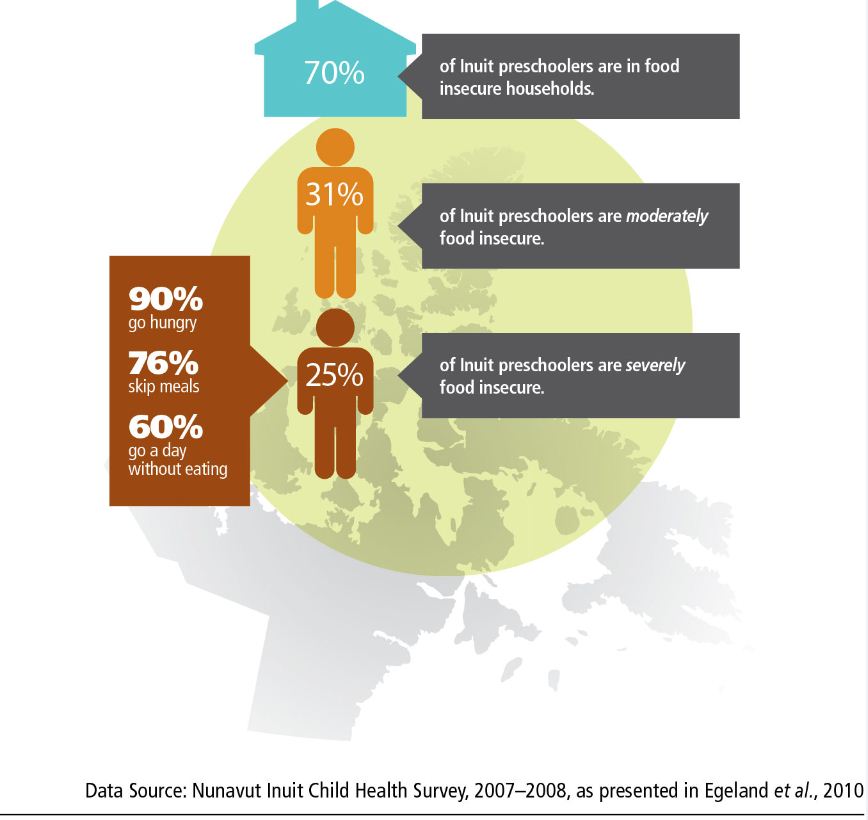
Since the publication, little seems to have changed for Israel – except for the drastic weight loss (that he ignores); his wife working full-time; and his staying home to take care of his youngest child, while his brother helps out with the children when they come home from school. Despite these new work arrangements, the high cost associated with hunting for country food, and the high price of store-bought groceries, continue to limit his family’s access to food. So Israel drinks tea instead of eating. And although he no longer bothers to measure how much weight he has lost, he knows that it’s close to 50 lbs. In a territory where 60% of children live in food insecure households, and 76% of severely food insecure children regularly skip meals, Israel is doing what he can for his own kids while they all wait for a better, long-term solution to the hunger problem. He believes that “the outcome is hard to predict but if we all (not just government but all, including business, Inuit organizations, and people) could all pitch in to make a difference then it would be, but we all know this is an on-going situation”. Today, Israel believes that education is key to helping him and his family to become more food secure. He’s focusing less on his weight loss and more on ensuring that his children get their education and “do better than me in life.”
Eight-year-old Kyle Mablick holds a sign in a food price protest that started around 1:00 p.m. in Iqaluit across the road from the Northmart store. (PHOTO BY JIM BELL)
Join Feeding My Family’s letter writing campaign to ask your Member or Parliament to find long term solutions to hunger and food insecurity in Canada’s north.
Ask the average Canadian to imagine the face of a malnourished child and chances are that he/she will describe someone living in a developing country. They would be shocked to learn that 7 out of 10 Inuit preschoolers live in food insecure households, and that Inuit households experience food insecurity at almost double the rate of the national average (27% vs. 12% respectively). Inadequate access to food is now commonplace in the North due to various socio-economic, developmental, geographic, and environmental factors at play. And the situation is only getting worse. An expert panel from the Council of Canadian Academies (CCA) concluded in a 2014 report to the Minister of Health that Northern Canada requires “urgent attention in order to mitigate impacts of health and well-being” among northern Aboriginal people. Vulnerable Inuit populations, including income-dependent elders, families, and single moms, are being severely impacted by continued food insecurity and poverty, with profound implications for the young. Inuit children aren’t just going to bed hungry: they are experiencing the effects of malnourishment from early stages in life, and they’re living with more nutrient-deficiency diseases today that could continue to affect their lives past adolescence and into adulthood.
Malnourishment in vulnerable Inuit households
Many Inuit households are being denied their basic human right to access adequate food. Among the most vulnerable are those who are disadvantaged socially and economically, with single mothers ranking very low on the scale. Factors that contribute to their food insecurity include living in a household without a hunter who is knowledgeable and financially-able to provide country food for the family, or living in a household without the purchasing power necessary to buy the outrageously-priced convenience foods that are flown into the region and sold in local stores. Mothers generally tend to forgo meals in order to provide enough for their families, and when pregnant, their food insecurity will likely result in serious malnourishment for both mother and infant.
The transition to a malnourished diet in Northern Canada
The westernization of many Inuit communities over the last 50 years has brought with it many changes to traditional lifestyles and diets. The expert panel of the CCA identified Northern communities as undergoing a “nutrition transition” due to the rapid shift from a traditional lifestyle to a westernized one. This has moved a large part of the Inuit population away from a nutrient-rich traditional diet to a low-nutrient, high-caloric diet. Children are adopting the new lifestyle quicker than adults and are therefore more prone to developing western diseases such as diabetes, obesity, and dental caries (tooth decay).
Physical effects of malnourishment on Inuit infants and children
The traditional Inuit diet provides an excellent source of nutrients needed by people living in an extreme cold, subsistence-living climate. Traditional foods, including hunted game, marine mammals, and local berries and fowl, are high in nutrients and thought to help the Inuit avoid diabetes and cardiovascular disease. The westernization of this diet substitutes these protective nutrients with high saturated fats, sodium, sugar and simple carbohydrates. The nutrition transition has caused a huge change in nutrient intake. For example, a staple in the traditional Inuit diet is caribou meat and offers twice the levels of protein and 1/10th the amount of saturated fat compared to tinned lunch meat. In addition, caribou and beaver meat both offer 9 and 14 times the amount of iron respectively than tinned meat. The substitution of these high-nutrient meats with processed, low-nutrient foods is causing a spike in the prevalence of anemia (low iron) and obesity among the Inuit:
Over half the children that participated in a 2007/2008 health study were identified as being overweight, highlighting the fact that kids are consuming high-caloric, low-nutrient foods.
Food insecure adults and children show more prevalence of malnutrition and disease, as well as a preoccupation with food scarcity, and a loss of control in their lives, all of which can lead to mental health issues (CCA report).
These and other behavioural issues can extend long-term as fluctuating malnutrition forces the body to enter a process of “nutrition triage”. Irregular access to food creates a natural condition in the body whereby survival and function supersede any non-basic functioning. In other words, the limited nutrients are prioritized to be used on a must-have basis, allowing the body to focus primarily on survival and growth, and less on learning and behavioural capabilities. These effects will extend into children’s lives and affect their future education, work and lives, with grave implications for the entire community.
Changing the face of malnutrition
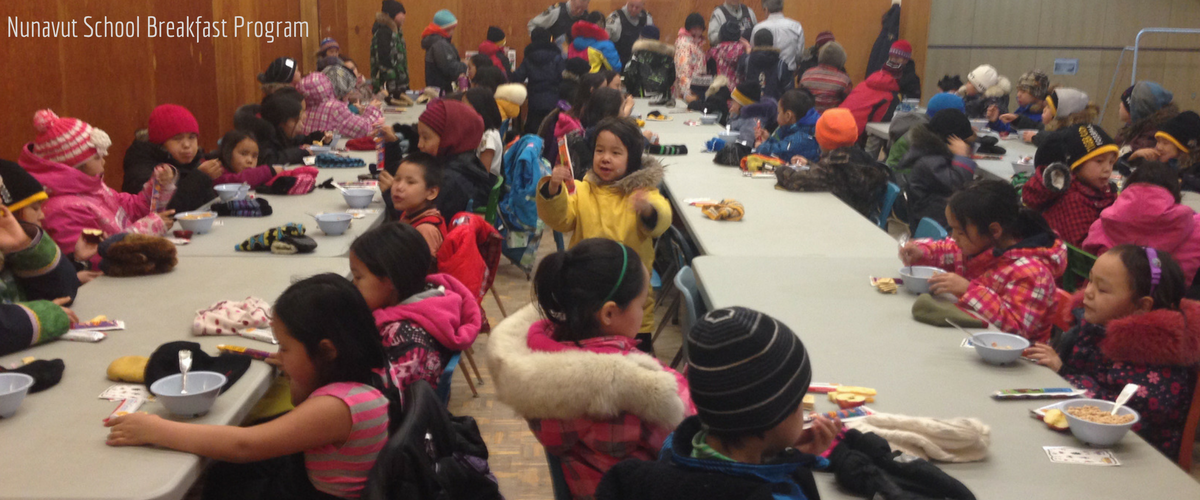
Food insecurity and poverty in Northern Canada require long-lasting, multiple-stakeholder, Inuit-centric solutions. Unfortunately, this will take time to plan and implement; time that Inuit children don’t have as they continue to feel the effects of malnourishment. They require immediate and regular access to adequate and nutrient-dense foods now. It’s time to raise awareness and funds to help stop hunger and change the face of malnourished children in the minds of Canadians. One interim solution is to support Nunavut school meal programs. Financial donations to these programs could have a lasting impact on reducing the number of Inuit children who continue to go to bed hungry today and on their health tomorrow.
When a food bank puts out a call for donations, Canadians may be motivated to share their boxes of mac n’ cheese, cans of baked beans, or schools of sardine tins that have been collecting dust in their pantry. But they shouldn’t fool themselves into believing that all food banks would welcome canned currency as a replacement for real dollars. Many food banks, soup kitchens, and school meal programs, like those operating in Northern Canada, would much prefer it if southern Canadians kept their lunch but shared their lunch money. They need financial donations so that they can serve a growing food insecure population; support a healthier community; and continue to play a central role in the preservation of culture through dietary traditions and lifestyles.
In southern Canada, food prices are generally stable and spike only when a cold snap affects the cost of imports from warmer climate countries, or when the Canadian dollar plummets. In Northern Canada, however, store-bought foods are flown-in and arrive to market with an outrageous price tag already attached. The high-cost of shipping heavily impacts donation packages too, sometimes exceeding the price of the canned items themselves because of their heavy weight and bulk. Food banks in Nunavut could make better use of these costs to serve their community on a regular basis.
⦁ Food banks and soup kitchens can purchase bulk or wholesale items at a fraction of the cost of buying and shipping donated retail food items.
Financial donations enable food programs to make locally-based decisions on how best to allocate their funds. Food banks can supplement a single family’s meal, or soup kitchens can purchase raw or bulk ingredients so that they can cook a meal for a larger group. Dollar for dollar it makes more fiscal sense to put funding into the hands of food banks that can make the money stretch instead of wasting funds on non-edible shipment costs.
⦁ Food banks and school meal programs can use monetary donations to ensure they support their community without major disruptions.
As food insecurity and poverty continues to rise in Nunavut, more pressure is placed on food programs to serve larger numbers of vulnerable people, and increasingly, more children. The Niqinik Nuatsivik Nunavut Food Bank is a good example of this growing need: it started serving 30 families when it first opened its doors in 2001, and now works hard to ensure that it has enough to provide for 120 families every two weeks. Rising food insecurity is also affecting school programs like the one at the Sam Pudlat school in Cape Dorset, Nunavut, that recently ran out of funding to provide hot breakfasts and healthy snacks for it’s students.
Financial donations would enable food banks to operate at higher capacities, and still have some funding to cover operational costs or unexpected emergency funds, like a burnt out stove element, or when the Canadian dollar drops drastically.
Northern food insecurity and poverty resulted from various socio-economic, political and colonial factors, including 30-year-long animal welfare campaigns that curtailed the Northern fur trade, and the primary loss of hunting and land skills, and the transfer of that knowledge to the next generation of Inuit, because of the high cost of hunting equipment, supplies and fuel. These and other circumstances have led to a ‘nutrition transition’ to processed, high-fructose, zero caloric foods due in part to cost, access, and an unfamiliarity with some raw unprocessed ingredients on store shelves. Western diseases like obesity, heart disease and diabetes are appearing in many Northern Inuit communities, in which case cheap, non-perishable foods from the south become wasteful and potentially harmful to people developing western nutrition-based illnesses.
⦁ Food banks are best equipped to understand the nutritional needs of local families and children, as well as and individuals’ health requirements, dietary needs, or personal preferences. Funding food banks helps to cut down on worsening health conditions by removing the possibility that shipments of high-fructose foods, for example, end up in the hands of pre-diabetics. Financial donations to school nutrition programs, like the Tusarvik School breakfast program in Naujaat, Nunavut, can be used to purchase fresh produce and healthy snacks for students who would otherwise not have access to them.
Food is an important element of identity and culture. When southern Canadians ship food up north, they unwittingly attach invisible strings to their packages. These food donations could result in a drastic alteration of the Inuit culture through an introduction to “acceptable” western dietary preferences and practices. Assimilated food customs and preparation methods can alter local opinion about traditional foods as being backwards or un-modern.
⦁ Food banks play an important role in cultural preservation
Food banks can preserve cooking knowledge, dietary customs and habits. They can minimize wasted food (and associated shipping losses) by feeding foods that are interesting, customary, or those that match a local preference. Soup kitchens can prepare and share recipes that do not require western cooking knowledge or that promote new-age health kicks.
⦁ Food banks play an important role in local hunting and economy
Food banks can purchase locally-available country food, like hunted seal or caribou, or they can subsidize a family’s meals with traditional bannock bread. Inuit children and youth are transitioning to the western diet faster than any other age group and therefore food banks could share or prepare meals that expose younger generations to “develop a taste for their own foods“.
Shipping cans to food banks in Nunavut simply does not make cents
Pantry castaways don’t fit the bill for every food bank, especially those that serve communities outside of a local food drive perimeter.
Shipping food to the north is a short-term Band-Aid solution to food insecurity, and is a waste of valuable funds. A family in southern Canada that buys$100 worth of food to ship to the north will likely have to pay more than $150 dollars in shipping costs. These are lost funds since the money could go further (and be spent more wisely) in the hands of food program managers. But the loss doesn’t stop there. Shipment costs are wasteful because southern shipments cannot take advantage of the Nutrition North Canada program (NCC), a federal government subsidy for commercial shipments of nutritious foods to the north. Local food programs across Nunavut can go beyond providing a single (and expensive) meal-in-a-box, if they are given the financial opportunity to do so. Southern Canadians need to put away the packing tape, and focus instead on putting the bank back into the food bank through hunger awareness campaigns like Feeding Nunavut’s Skip-a-Meal campaign.
Additional resources
Read Food Bank Canada’s HungerCount 2015, a report from an annual study of more than 4,000 food banks and programs in every province and territory across Canada.
Northern food banks and soup kitchens, rely on donations from people like you to serve the need in their communities. Please support their important work.
Feeding Nunavut is incorporated under the Canada Not-for-profit Corporations Act. Registered in Ontario and Nunavut.
We support northern community-based programs to help these programs better serve the needs of their communities.




 Changing the face of malnutrition


 Feeding Nunavut is incorporated under the Canada Not-for-profit Corporations Act. Registered in Ontario and Nunavut.
We support northern community-based programs to help these programs better serve the needs of their communities.
Feeding Nunavut is incorporated under the Canada Not-for-profit Corporations Act. Registered in Ontario and Nunavut.
We support northern community-based programs to help these programs better serve the needs of their communities.